Mobile Money and Fintech for Ghanaian SMEs: A Practical 2026 Guide to Payments, Savings and Credit
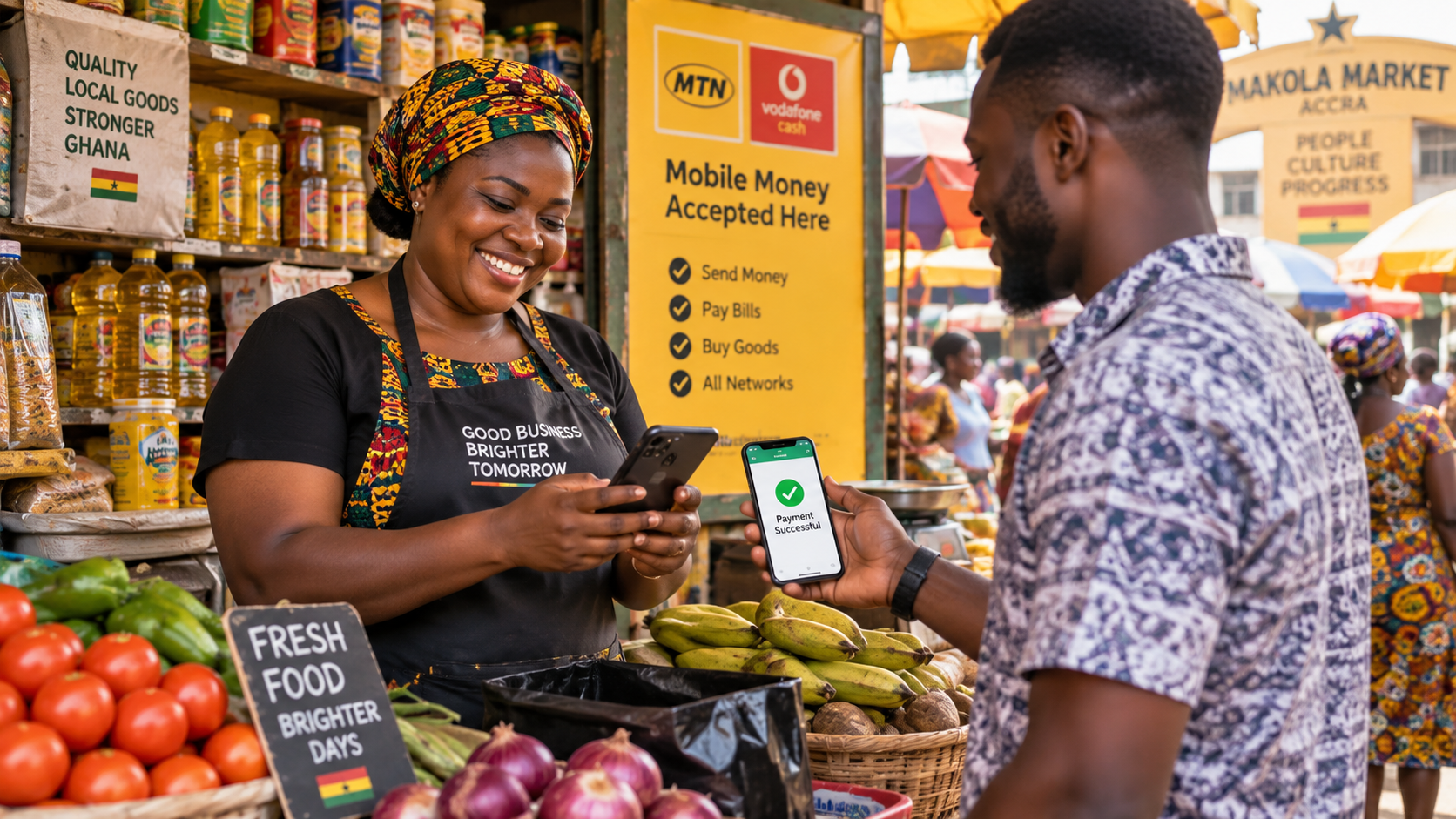
Mobile money has become part of everyday commerce in Ghana. Customers expect to pay by phone, suppliers accept transfers, and a growing number of fintech platforms now offer Ghanaian businesses tools for collections, payouts, reconciliation and even short-term credit. For an SME owner, this creates real opportunity — but also real risk if the tools are used without a clear plan.
This guide covers the main mobile money platforms and fintech services available to Ghanaian SMEs in 2026, what each one is actually licensed to do, and a practical step-by-step approach to using them safely. It draws on verified information from Bank of Ghana data, operator websites and licensed provider disclosures. Where specific figures could not be independently confirmed, qualitative language is used instead.
The scale of mobile money in Ghana
Ghana's mobile money market continued to expand strongly in 2025. Total annual transaction value reached GH¢4.54 trillion, up from GH¢3.01 trillion in 2024 — a rise of more than 50%. Transaction volume grew from 8.09 billion to 9.70 billion over the same period. At the end of 2025, Ghana had approximately 26.6 million active mobile money customers and around 491,000 active agents.
These figures confirm that customers are already comfortable with digital payments. For an SME, the practical implication is straightforward: accepting mobile money is no longer optional if you want to serve the broadest possible customer base. The question is not whether to use it, but how to use it in a way that supports your business rather than creating confusion or risk.
What the three main operators offer businesses
Each of Ghana's three main mobile money operators — MTN, Telecel and AT — offers a dedicated merchant account that is separate from a personal wallet. Registering as a merchant, rather than directing sales to a personal number, is the single most important step an SME can take.
MTN MoMo allows businesses to register through its merchant and agent onboarding portal. A dedicated merchant wallet accepts customer payments and can be linked to a business bank account. MTN also confirms that MoMo users can access savings and loan products through the platform, though eligibility and terms vary and must be confirmed directly with MTN or the named financial partner behind any offer.
Telecel Cash offers a formal merchant application requiring business details, a Ghana Card and a live photograph. Its verified savings product, Red Save, is operated in partnership with First Bank Ghana. Treat Red Save as a separately governed product with its own terms — it is not the same as holding a balance in a Telecel Cash wallet. ATMoney (formerly AirtelTigo Money) provides a dedicated merchant portal for authorised business users. Confirm current product availability, settlement timelines and support channels directly with AT before onboarding.
Fintech platforms: payment processors versus lenders
A payment gateway helps your business collect or send money. A lender advances credit. These are different services, even when both appear in the same app or use mobile money rails. Understanding this distinction protects you from misusing a tool or taking on debt you did not intend.
Hubtel is a licensed Enhanced Payment Service Provider. It enables businesses to accept MTN MoMo, Telecel Cash, ATMoney, bank-account and card payments through APIs, hosted checkout, USSD and payment links. It also supports disbursements and provides a dashboard for transaction tracking, invoicing and reporting. Paystack Payments Limited is licensed by the Bank of Ghana and enables businesses to accept mobile money, cards, bank-account payments, bank transfers and USSD. expressPay is a Ghanaian payment gateway and official Visa Payment Technology Provider supporting cards, mobile money, Android POS devices, merchant QR codes, bulk payments and USSD.
Fido Micro Credit is a Bank of Ghana-licensed digital credit provider. Its FidoBiz product offers business loans of up to GH¢8,500, subject to eligibility and assessment. Applicants need a Ghana Card and an active mobile money account. Published terms indicate repayment periods of 90 to 365 days and a maximum annual percentage rate of up to 70% for some offers — so calculate the full repayment cost carefully before accepting any offer. One important caution: Zeepay's DEMI licence was reported as revoked by the Bank of Ghana in July 2026 for regulatory breaches. Verify any provider's current licence status directly with the Bank of Ghana before using their services.
The Bank of Ghana regulatory framework
The Payment Systems and Services Act, 2019 (Act 987) governs Ghana's payment ecosystem and gives the Bank of Ghana authority to license and supervise mobile money operators and fintech payment providers. The framework distinguishes between Dedicated Electronic Money Issuers, Enhanced/Medium/Standard Payment Service Providers, and Payment and Financial Technology Service Providers — each with different permitted activities.
Ghana scored 96.10% in the 2025 GSMA Mobile Money Regulatory Index, retaining the top position for that index. The Bank of Ghana's FinTech and Innovation Office, established in 2020, oversees licensing in this area. A strong national framework does not remove merchant-level risk, however. Always confirm that a provider holds the correct licence for the specific service it is offering you.
A six-step implementation playbook for SMEs
The following steps are designed to help you build a controlled, scalable mobile money setup rather than simply accepting transfers into a personal number.
Start by separating business from personal finances: open a dedicated merchant wallet and maintain a business bank account as the main destination for retained cash. Display the correct merchant name and payment instructions to customers, and always confirm a payment independently in your merchant portal before releasing goods — never accept a screenshot as proof. Reconcile every day by comparing sales records, confirmed wallet transactions, charges deducted, cash-outs and actual bank settlements. Investigate any difference promptly.
Add a licensed payment service provider such as Hubtel, Paystack or expressPay only when your business genuinely needs cards, online checkout, payment links, QR codes or automated reporting. Transfer an agreed portion of collections to your business bank account on a regular schedule rather than holding large balances in a wallet. And if you consider mobile-money-linked credit, write down the exact business use, total repayment amount, all fees, due dates and a fallback plan before accepting any offer.
- Open a merchant wallet — not a personal number — for all business collections.
- Confirm every payment in your portal before releasing goods or services.
- Reconcile wallet, gateway and bank records every day.
- Add a payment service provider only when complexity justifies it.
- Transfer surplus balances to a business bank account regularly.
- Borrow only for a defined, repayable purpose with a clear cash-flow plan.
Key risks and how to manage them
Fraud and social engineering remain serious risks in Ghana's mobile money environment. Never disclose a PIN, password or one-time password to a caller, customer, agent or supposed support officer. Restrict which staff members can initiate payouts, approve refunds or change settlement details, and remove access immediately when a worker changes role or leaves.
Plan for network and liquidity interruptions by maintaining more than one approved collection method, but do not release goods during an outage without independent confirmation. Finally, retain all invoices, settlement reports, fee statements and refund records. Mobile money does not remove your tax or record-keeping responsibilities — ask a qualified adviser how transaction charges, sales and business taxes should be recorded for your specific circumstances.
Key takeaways
- Open a dedicated merchant wallet — not a personal number — to keep business and personal finances separate.
- Always confirm a mobile money payment independently in your merchant portal before releasing goods or services.
- Reconcile your wallet, gateway and bank transactions every day to catch errors and build clean financial records.
- Assess fintech providers by their Bank of Ghana licence type: payment processors and lenders are different services.
- Before taking any mobile-money-linked credit, calculate the total repayment cost and ensure it fits your cash flow.
This article is provided for general information only and does not constitute financial advice. Programmes, rates and regulations referenced may change. Please verify details directly with the relevant institutions or authorities before making decisions.